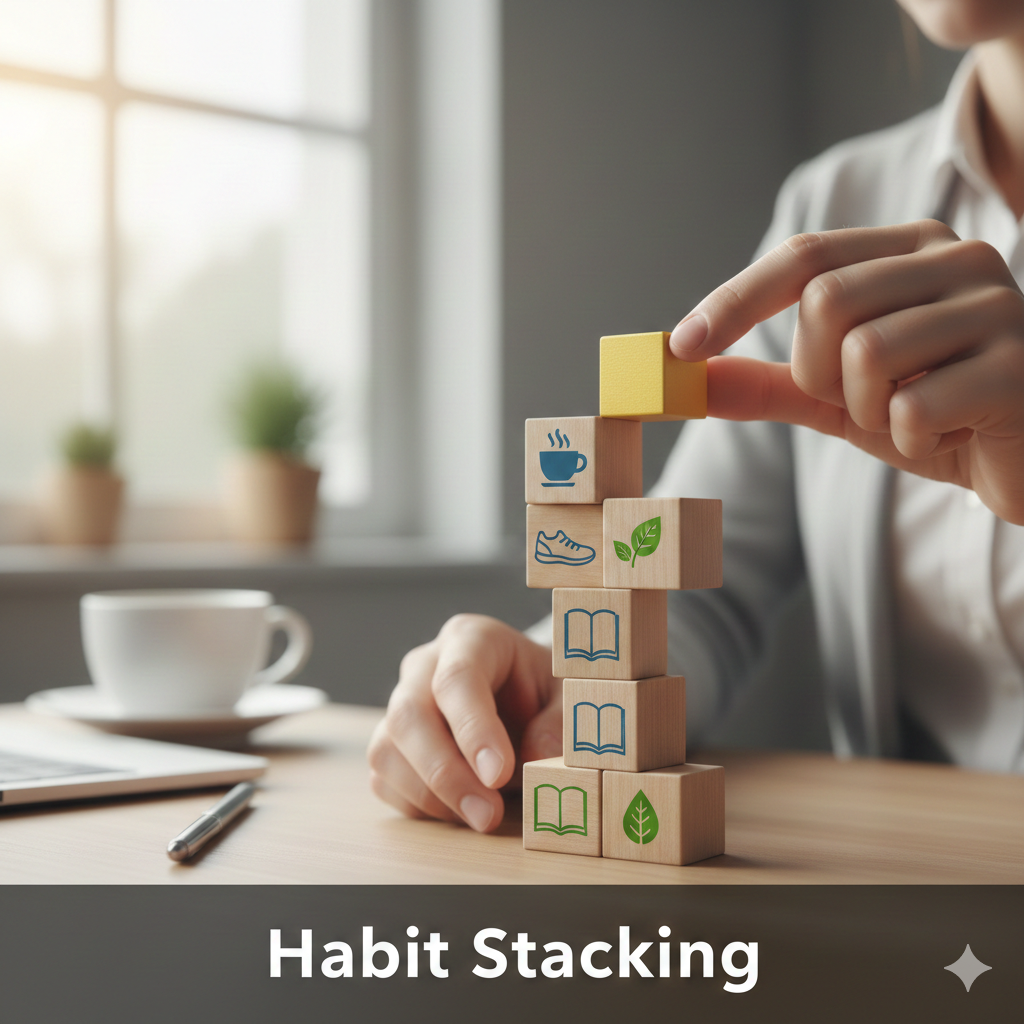
Have you ever wondered why it’s so easy to brush your teeth every morning, but so hard to remember to meditate or take your vitamins? The answer lies in the way your brain is wired.
Most people approach change with motivation, but motivation is a fickle friend. To build a life that reflects your goals, you don’t need more willpower—you need a better architecture.
This is where Habit Stacking comes in. In this comprehensive guide, we will break down the science, the strategy, and the common pitfalls of this life-changing technique.
Phase 1: The Neuroscience of Habit Stacking
To understand why Habit Stacking works, we have to look inside the brain. Your brain is filled with billions of neurons, but the most important ones are those connected by Synaptic Pruning.
As you grow, your brain strengthens the connections between neurons that are used frequently. For example:
- When you make coffee, your brain has a “highway” of neurons dedicated to that task.
- When you drive home, you often arrive without “thinking” because the neural pathway is so strong.
Habit Stacking works by “hitching a ride” on these existing highways. Instead of trying to build a new road from scratch, you simply add a small exit to an established route.
Phase 2: The Logic of “Anchor Habits”
The secret to a successful stack is the Anchor. An anchor is a habit you already do with 100% consistency.
Examples of Strong Anchors:
- Getting out of bed.
- Brewing the first cup of coffee.
- Sitting down for dinner.
- Closing your laptop at the end of the workday.
- Putting on your pajamas.
The Golden Rule: Your anchor must be unshakable. If you choose “going to the gym” as an anchor, but you only go twice a week, your stack will fail. Choose something you do every single day, without fail.
Phase 3: The Step-by-Step Blueprint to Your First Stack
Step 1: Brainstorm Your Current Habits
Take a piece of paper and write down two columns. In the first column, list things you do every day without fail:
- Wake up.
- Make the bed.
- Shower.
- Pour coffee.
- Eat lunch.
- Turn off the lights.
Step 2: Match the Frequency
If you want to build a habit of “writing a gratitude journal,” don’t stack it after “showering” if you shower at different times every day. Match a morning habit with a morning desire.
Step 3: Use the Formula (The James Clear Method)
After [Current Habit], I will [New Habit].
Phase 4: Advanced Stacking (The Chain Effect)
Once you master a single stack, you can create a Habit Chain. This is how high-performers automate their entire day.
Example of a Morning Chain:
- After I pour my coffee, I will meditate for 60 seconds (Stack 1).
- After I finish meditating, I will write my to-do list for the day (Stack 2).
- After I write my to-do list, I will immediately start my most important task (Stack 3).
By the time you finish your coffee, you have already meditated, planned your day, and started working—all with zero willpower.
Phase 5: Common Mistakes (And How to Fix Them)
Even the best-laid plans can fail. Here is why Habit Stacking sometimes doesn’t work:
- The New Habit is Too Big: If you say “After I brush my teeth, I will work out for an hour,” you will fail. Fix: Make it “I will do 5 pushups.”
- The Trigger is Vague: “After work” is a mood, not a trigger. Fix: Use a specific action: “After I close my laptop.”
- Lack of Environment Design: If you want to read after coffee, but your book is in the other room, the friction is too high. Fix: Place the book on the coffee machine the night before.
Phase 6: Case Study: From Chaos to Consistency
Consider “John,” a busy professional who wanted to improve his health.
- Old Way: John tried to go to the gym after work but was always too tired.
- The Habit Stack Way: John decided to stack a “Green Smoothie” habit. Formula: “After I walk into the kitchen from work, I will put a handful of spinach in the blender.”
- The Result: Because the action was so small and the trigger (walking into the kitchen) was so consistent, John hasn’t missed a day in 6 months.
Final Thoughts: The Compound Effect
Habit stacking isn’t about massive changes overnight. It’s about the 1% improvement. When you stack small habits, they compound over weeks and months into a completely different life.
Your Action Step for Today: Look at your morning routine. What is one tiny habit you can “stack” tomorrow morning? Leave a comment below and let us know what your stack is!