In our pursuit of the Zenith—the highest point of our potential—we often hit a wall. We start a new routine with fire and passion, only to find that flame flickering out within weeks. At Habit Zenith, we’ve analyzed why this happens. The problem isn’t your willpower; it’s the level at which you are trying to change.
Most people focus on what they want to achieve (Outcomes). High achievers focus on who they wish to become (Identity). This guide will break down the science of Identity-Based Habits and show you how to rewrite your internal script for automatic success.
1. The Anatomy of Change: The Three Layers
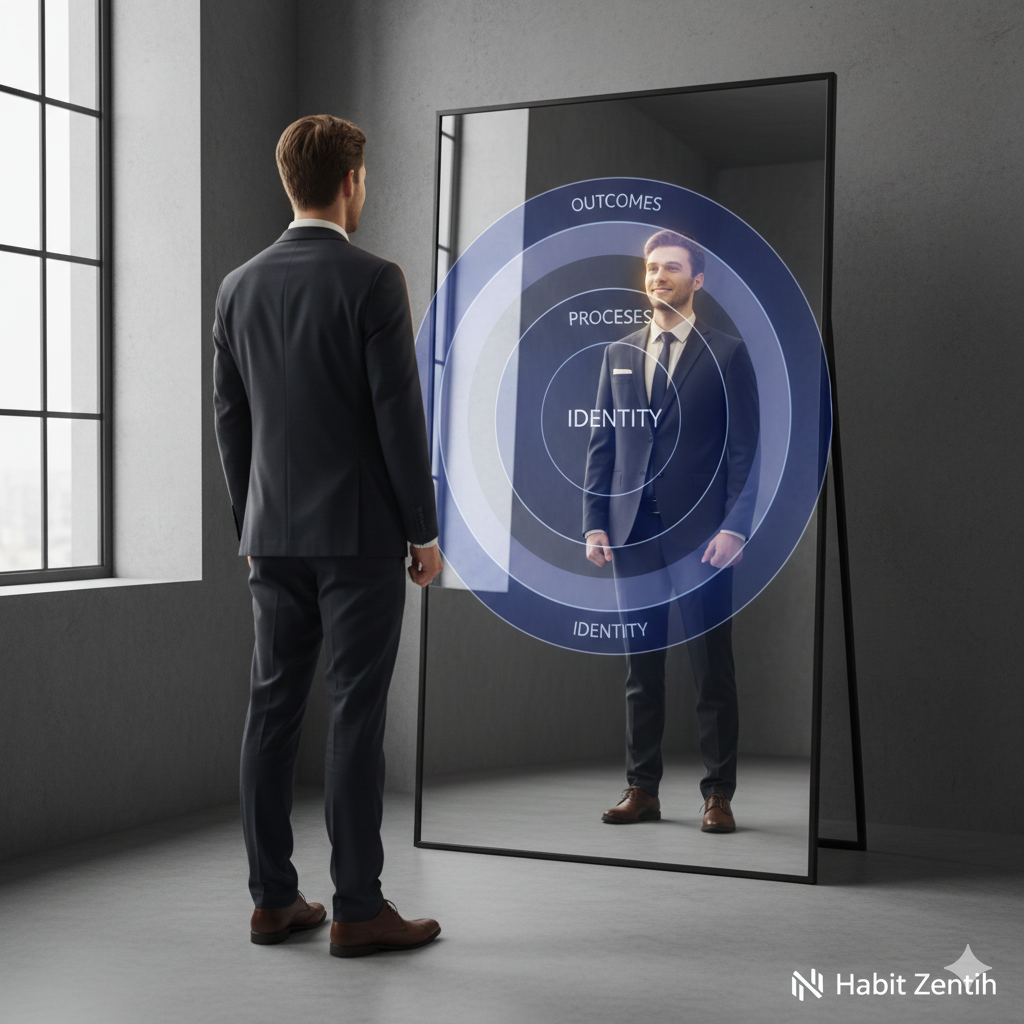
Imagine your personality is like an onion with three distinct layers. To change permanently, you must understand where you are currently aiming.
Layer 1: Outcomes (The Outer Layer)
This is about Results. Most of the goals people set fall here: losing 20 pounds, publishing a book, or making six figures. Outcomes are about what you get.
Layer 2: Processes (The Middle Layer)
This is about Systems. This involves your habits and routines: your workout split, your morning meditation, or your workflow at the office. Processes are about what you do.
Layer 3: Identity (The Core)
This is about Beliefs. This is the deepest level, containing your worldviews, your self-image, and your judgments about yourself and others. Identity is about what you believe.
The “Inside-Out” Secret: Most people start from the outside in. They say, “If I lose weight (Outcome), then I’ll follow this diet (Process), and then I’ll be a healthy person (Identity).” The Zenith Way flips this: “I am a healthy person (Identity), therefore I eat like this (Process), and consequently, the weight stays off (Outcome).”
2. The Mechanics of “Voting”: How Identities are Built
Your identity is not an innate trait you are born with; it is a social and psychological construct built through evidence. #### Every Action is a Vote Think of every action you take as a “vote” in an election for the person you want to become.
- If you go to the gym once, you aren’t an athlete yet. But you have cast a vote for an Athletic Identity.
- If you write one paragraph, you haven’t written a novel. But you have cast a vote for a Writer Identity.
The Need for Proof
The human brain is logical. It won’t believe you are “organized” if your room is a mess and you miss every deadline. To change your identity, you don’t need “positive affirmations” alone; you need evidence. Once the evidence of your new habit outweighs the evidence of your old one, your brain naturally adopts the new identity. You don’t have to “try” anymore—you just act in alignment with who you are.
3. The 4-Step Protocol for Identity Transformation
Step 1: Define the “Person,” Not the “Goal”
Instead of saying, “I want to be a millionaire,” ask yourself: “What are the qualities of a person who is financially free?”
- They are disciplined.
- They are lifelong learners.
- They are risk-takers. Your goal is now to become a “disciplined learner,” not to get the money. The money is a side effect of the identity.
Step 2: Prove it with “Micro-Wins”
To win the election, you don’t need a landslide; you just need a majority.
- Don’t try to run a marathon on Day 1. Just put on your running shoes.
- Why? Because putting on the shoes is a vote. It’s an easy win that provides the “proof” your brain needs.
Step 3: The “I Am” Language Shift
The words following “I am” are instructions to your subconscious.
- The Amateur: “I’m trying to wake up early.” (Identity: A night owl fighting themselves).
- The Master: “I am an early riser.” (Identity: Someone whose nature is to be up with the sun). Shift your language from “doing” to “being.”
Step 4: Perform an Identity Audit
At the end of each week, ask: “Did the majority of my actions today align with my Zenith Identity?” This keeps you conscious of the votes you are casting.
4. Case Study: The “Programmer” vs. The “Student”
Two people start learning to code.
- Person A (Outcome-Focused): Wants to finish a Python course to get a job. When they hit a bug that takes 5 hours to fix, they feel frustrated and quit because the “Outcome” (the job) feels too far away.
- Person B (Identity-Focused): Decides they are a Programmer. To them, a programmer is someone who solves logic puzzles. When they hit the same bug, they don’t quit. They think, “Solving this is what programmers do.” Their identity keeps them in the game long enough to succeed.
5. Overcoming the “Identity Conflict”
The biggest barrier to change is your Old Identity. You might have years of evidence telling you: “I’m bad at math,” “I’m a procrastinator,” or “I’m not creative.” These aren’t facts; they are just old “votes.” To break them, you must overwhelm the old evidence with new, small actions. This is why the “Never Miss Twice” rule is so vital—it prevents the old identity from gaining back its majority.
6. Conclusion: Reaching Your Identity Zenith
Consistency is no longer a chore when you are doing what is natural to you. Identity-based habits make success automatic. You don’t need willpower to breathe, and you won’t need willpower to excel once those actions define who you are.
Your Action Step: Don’t ask what you want to achieve today. Ask: “Who am I becoming today?”