Most people treat consistency like a test of character. They think, “If I were stronger, I’d wake up early,” or “If I had more discipline, I’d stop scrolling on my phone.”
At Habit Zenith, we challenge this notion. Consistency isn’t a character trait; it’s an architectural outcome.
If you want to reach your Zenith, you must stop being a victim of your surroundings and start becoming the Architect of your Environment. This is the ultimate “Consistency Secret”: making good habits inevitable and bad habits impossible.
1. The Friction Theory: The Physics of Behavior
Every action has a Friction Coefficient. In the same way that a car requires more fuel to drive uphill, your brain requires more “Willpower Fuel” to perform habits in a high-friction environment.
- High Friction: Your gym clothes are in the laundry, your headphones are dead, and the gym is across town. (Willpower required: Extreme)
- Zero Friction: You sleep in your workout clothes, your shoes are by the door, and you have a 10-minute workout video ready on your screen. (Willpower required: Minimal)
The Rule: If you find yourself failing at a habit, don’t blame your mind. Audit your friction.
2. Strategic Priming: The “Mise en Place” of Success
In professional kitchens, chefs use a system called Mise en Place (everything in its place). They don’t start cooking until every ingredient is chopped and ready.
You can “Prime” your life using the same logic:
A. The “Night-Before” Setup
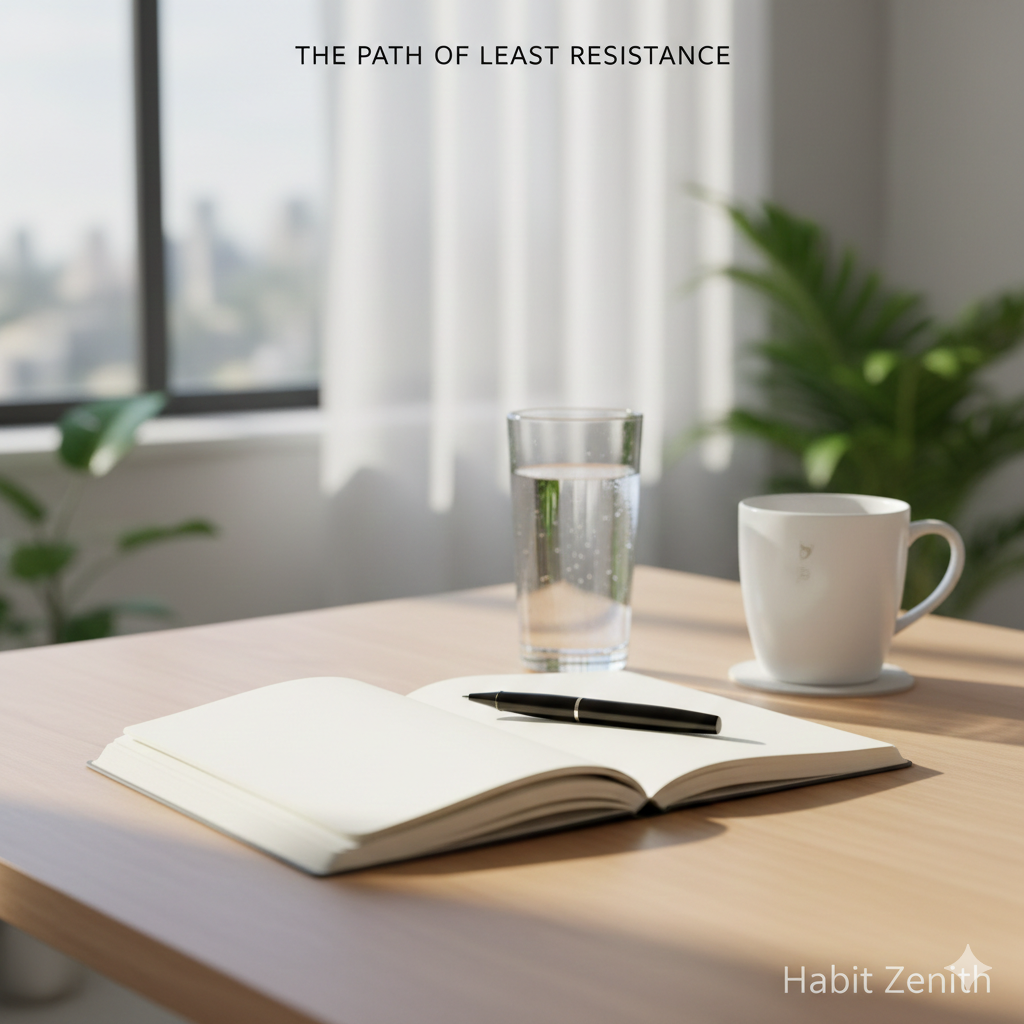
Spend 5 minutes every evening preparing the first step of your morning habit.
- For Writing: Open your laptop and the specific document you need before you go to sleep.
- For Nutrition: Place your vitamins and a full glass of water on the kitchen counter.
B. The “2-Minute Reset”
Before you leave a room, reset it for your future self. If you plan to read on the sofa later, clear the clutter and place your book on the cushion now. You are literally making a gift of “easy action” for your future self.
3. Visual Cues: Out of Sight, Out of Habit
The human brain is a visual machine; nearly 50% of its processing power is dedicated to vision. If you don’t see a cue for your habit, the neural pathway remains dormant.
- The Problem: We hide our goals in drawers, apps, and cabinets.
- The Zenith Solution: Use Environmental Anchors.
- Want to drink more water? Place 3 bottles in the 3 places you spend the most time.
- Want to practice guitar? Take it out of the case and put it in the middle of the living room.
4. The Digital Environment: The Hidden Friction
In 2026, your “environment” is more than just your physical room—it’s your phone. If your home screen is filled with red notification bubbles and social media icons, you are designing an environment for distraction, not Zenith.
- Action: Move all “Infinity Pool” apps (Instagram, TikTok, X) off your first screen.
- Action: Use “Grayscale Mode” to make your phone less hits-of-dopamine friendly.
5. Summary Checklist: The Environment Audit
To master this Consistency Secret, perform this audit today:
- [ ] Identify the Friction: What is the most annoying step of your habit?
- [ ] Eliminate the Step: How can you remove that step entirely?
- [ ] Add a Visual Cue: What physical object can you place in your path?
- [ ] The “Inversion” Rule: For bad habits, increase friction. (e.g., put the TV remote in a different room).
Final Thoughts: Engineering Your Zenith
Willpower is a finite battery; it drains as the day goes on. Environment design is a permanent power source. By shaping the world around you, you ensure that even on your worst days, your environment pulls you toward your best self.
Your Action Step: Choose your most important habit. Tonight, reduce its friction by one step. Prepare the environment so that tomorrow morning, you don’t even have to think.